


Transformational Generative Grammar (TG), proposed by Noam Chomsky in the mid-20th century, is based on the assumption that sentences are of two types—those with the simplest structures are called kernel or basic sentences, while more complex sentences can be derived from these kernels through transformations. Kernel sentences form the foundation of linguistic structure; they are simple, active, affirmative, and declarative constructions from which all other sentence forms (passive, interrogative, negative, etc.) can be generated.
A kernel sentence is first analysed with the help of Phrase Structure (PS) Rules, as discussed under Immediate Constituent (IC) Analysis, and then processed through Transformational Rules to arrive at a surface structure. Thus, a kernel sentence represents the deep structure—the underlying syntactic pattern that encodes meaning—while the application of transformational rules produces the surface structure—the final, spoken or written form.
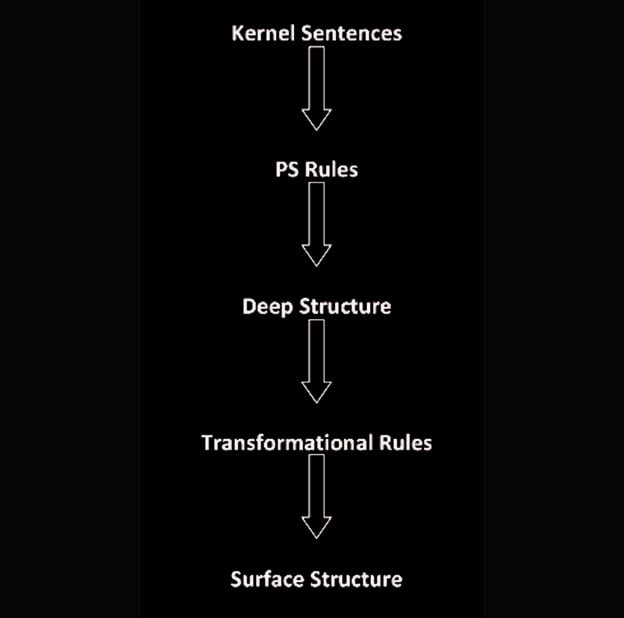
The notion of a rule is fundamental to TG. It is a rule-based grammar where each rule has a generative role in producing all and only the grammatical sentences of a language. These transformational rules (T-rules) differ from traditional prescriptive rules; they describe how linguistic competence enables speakers to generate an infinite number of sentences from a finite set of means. TG grammar involves three major components:
- The Base Component / Phrase Structure
- The Transformational Component
- The Morpho-phonemic Component
The Base Component / Phrase Structure (PS) Component
Phrase structure rules form the base component of the grammar. Using rewrite or PS rules, the base component generates the underlying structure of a kernel sentence in the form of a syntactic string.
E.g., He drew the picture.
After applying PS rules:
S → NP + MV + Det + N
This is the kernel string or deep structure, representing the grammatical framework upon which transformations will operate.
The Transformational Component
The transformational component converts the output of the phrase structure into a more complex terminal string by applying T-rules.
There are two types of transformational rules:
- Optional T-rules (E.g., passive transformation, interrogative transformation)
- Obligatory T-rules (E.g., number transformation, ensuring subject–verb agreement)
Transformations are also classified as:
- Singular Transformations, operating on a single string
- Generalised Transformations, combining two or more strings
Each T-rule consists of two parts:
- Structural Description (SD): the representation of the phrase structure of the kernel sentence
- Structural Change (SC): the representation of the sentence after transformation
The Morpho-phonemic Component
This component converts the output of the transformational stage into phonemic or morphologically realised form. It handles pronunciation, inflexion, and morphological adjustments to ensure that the generated strings correspond to actual utterances. It essentially bridges the gap between abstract syntactic forms and real linguistic performance.
Competence
Chomsky introduced the concept of linguistic competence to explain the innate mental capacity of native speakers to generate and understand an infinite number of grammatical sentences in their language. Competence refers to the internalised knowledge of the rules and principles that constitute a speaker’s language system. It exists at the level of the ideal speaker-hearer, unaffected by performance errors such as hesitation, slips of the tongue, or memory lapses. In TG grammar, competence represents the underlying system of abstract grammatical rules that govern sentence formation. This concept allows linguists to distinguish between what language users know and how they use that knowledge, providing a theoretical foundation for understanding the generative capacity of the human mind.
Performance
Performance, in contrast to competence, refers to the actual use of language in concrete situations. It is the observable realisation of linguistic competence through speaking, writing, and comprehension. Performance can be influenced by external factors such as memory limitations, attention, fatigue, or social context, which may lead to grammatical deviations or incomplete utterances. In Chomsky’s framework, performance data help linguists understand how linguistic structures are processed and produced, though they do not always reflect the ideal grammatical knowledge (competence) of a speaker. In TG grammar, the distinction between competence and performance is crucial because it allows the study of language as both a mental system (competence) and a behavioural phenomenon (performance), combining cognitive and communicative perspectives.
TG Grammar is generative because it seeks to generate all grammatical sentences and exclude ungrammatical ones. A strong TG model must produce every sentence that is well-formed in the language and reject ill-formed ones. It operates through formalised rules, making it a systematic and predictive model of linguistic behaviour. By integrating the concepts of deep and surface structure, phrase and transformational components, and the distinction between competence and performance, Chomsky’s framework revolutionised modern linguistics, shifting focus from descriptive traditions to a cognitive-scientific understanding of how language is structured and generated in the human mind.




























Excellent job, Devika. You really are an asset to the teaching profession.