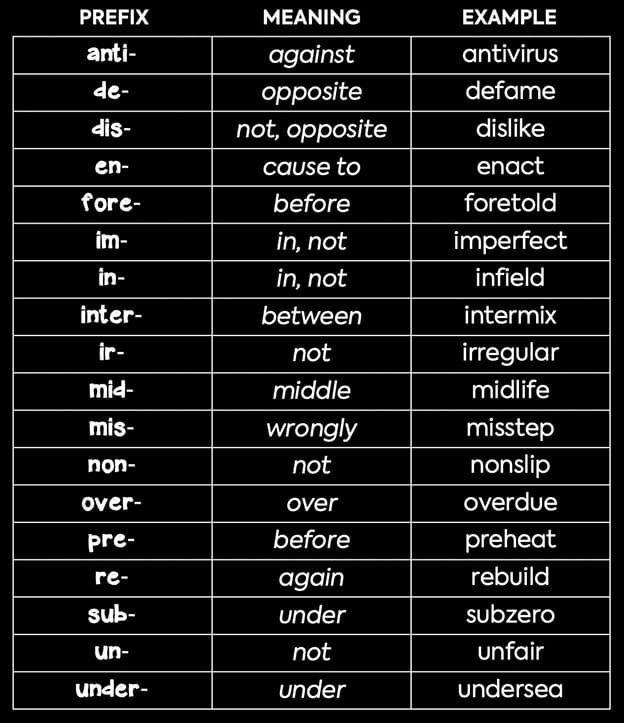
Prefixes and suffixes are important elements of word formation in the English language. A prefix is added to the beginning of a word to modify its meaning, while a suffix is added to the end of a word to change its grammatical form or function. Together, they help expand vocabulary, create new words, and express ideas more precisely. Understanding prefixes and suffixes also improves reading comprehension and word analysis, as many complex words can be broken down into smaller, meaningful units.
Prefixes to Suggest Numbers / Quantity / Degree
- The prefix semi- means half or partly, as in semicircle, which refers to half a circle.
- The prefix centi- relates to one hundred or a central division, as in century, which means one hundred years.
- The prefix multi- means many, as in multinational, which refers to something involving many nations.
- The prefix uni- means one, as in uniform, which suggests one form or type.
- The prefixes bi- or di- mean two, as in bicycle, which has two wheels.
- The prefix tri- means three, as in triangle, which has three sides.
- The prefix poly- means many, as in polyglot, which refers to someone who knows many languages.
Prefixes Used to Make Antonyms
- The prefix un- means not, as in unhappy, which means not happy.
- The prefixes in-, im-, il-, and ir- all mean not, as in incorrect, impossible, illegal, and irregular.
- The prefix non- means absence or lack, as in nonviolent, which means not violent.
- The prefix dis- indicates the opposite or absence, as in disagree, which means to not agree.
- The prefix mis- means wrongly or incorrectly, as in misunderstand, which means to understand wrongly.
Prefixes to Form Verbs
- The prefixes en- and em- mean to cause or make, as in enable, which means to make able, and empower.
- The prefix be- means to make or affect, as in befriend, which means to act as a friend.
- The prefix re- means again, as in rewrite, which means to write again.
- The prefix de- means to remove or reverse, as in decode, which means to remove a code.
- The prefix over- means excessively, as in overwork, which means to work too much.
Other Prefixes
- The prefix pre- means before, as in preview, which means to view beforehand.
- The prefix post- means after, as in postwar, which refers to the period after a war.
- The prefix sub- means under or below, as in submarine, which operates under water.
- The prefix super- means above or beyond, as in superhuman, which means beyond normal human ability.
- The prefix inter- means between, as in international, which involves multiple nations.
- The prefix trans- means across or beyond, as in transport, which means to carry across.
Suffixes to Form Nouns
- The suffixes -er and -or indicate a person who performs an action, as in teacher and actor.
- The suffix -ness indicates a state or quality, as in happiness.
- The suffixes -tion and -sion indicate an action or process, as in education and decision.
- The suffix -ment indicates a result or condition, as in development.
- The suffix -ity indicates a quality or state, as in purity.
Suffixes to Form Adjectives
- The suffix -ful means full of, as in hopeful, which means full of hope.
- The suffix -less means without, as in careless, which means without care.
- The suffix -ous means full of or having qualities of, as in dangerous.
- The suffixes -able and -ible mean capable of, as in readable and visible.
- The suffix -ive means having the nature of, as in creative.
Suffixes to Form Verbs
- The suffixes -ise and -ize mean to make or become, as in modernise, which means to make modern.
- The suffix -en means to become or make, as in strengthen, which means to make strong.
- The suffix -ify means to make or cause, as in simplify, which means to make simple.
Other Suffixes
- The suffix -ly forms adverbs, as in quickly, which describes how an action is done.
- The suffixes -ward and -wards indicate direction, as in forward.
- The suffix -hood indicates a state or condition, as in childhood.
- The suffix -ship indicates a relationship or status, as in friendship.
- The suffix -ist indicates a person or belief system, as in artist or socialist.

Prefixes and suffixes are essential tools for understanding and building words in English. They allow speakers and writers to modify meaning, change grammatical categories, and create new vocabulary. By recognising these elements, it becomes easier to analyse unfamiliar words and use language more effectively.